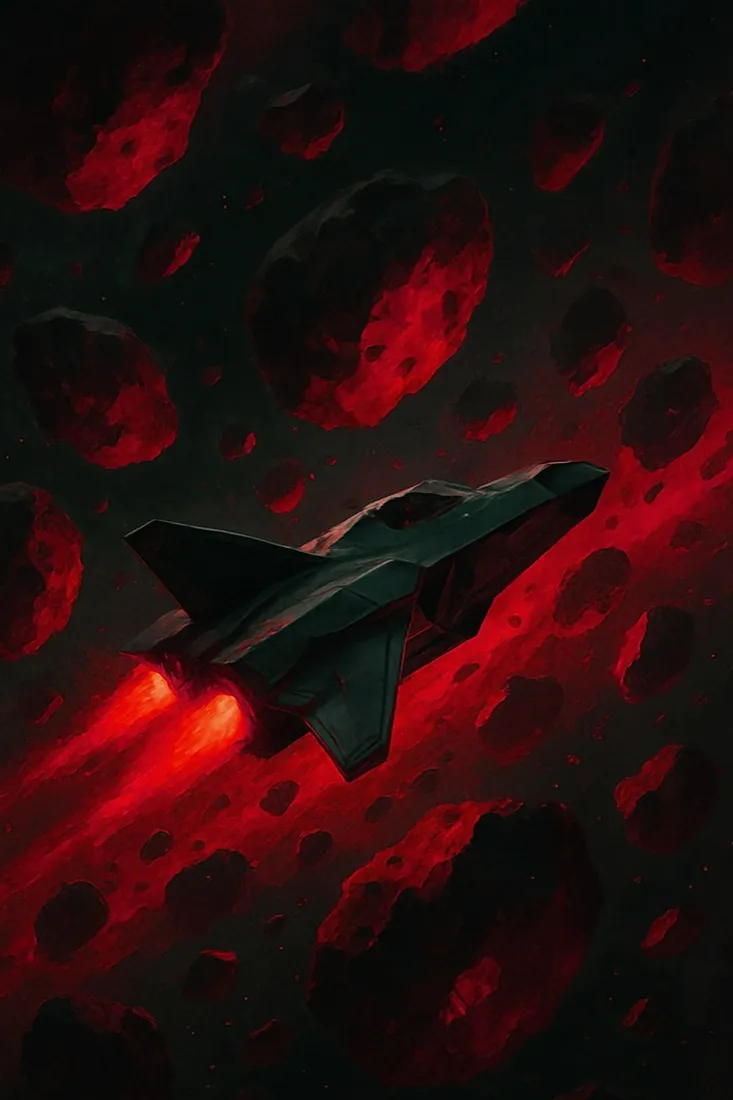
Starblast.io has one of the quickest starts on our list. Open the page, choose a mode and you are flying, no account required. Then it does something unusual for a quick-match game: it tells you, gently, that you are not ready to fight yet. Your starting ship is small and fragile, and the space around you is full of asteroids worth breaking open.
That shift in pace is what makes Starblast special. A match is not one fight but a growth curve. You mine gems, spend them on upgrades or a bigger ship, and gradually turn from target into threat. The early minutes feel like a quiet puzzle and the later ones like a war. If you like watching a plan come together, this is the most satisfying game on our rink.
Mining gems before you start any fights
Asteroids drift across every map, and shooting them breaks them into gems you can collect. Your ship can only hold so many, and capacity grows as you climb to bigger hulls, so the early game is a loop of mining, filling up and spending. It sounds simple, but it hides real decisions: whether to invest gems in your current ship’s stats or save toward the next tier, and when to stop mining and start hunting.
Those decisions matter because other pilots are making them too. A player who rushed to a bigger hull might be powerful but fragile, while one who maxed out every stat on a small ship can be surprisingly hard to pin down. Learning to read what an opponent has invested in, just by watching how it moves and fires, is one of the quiet pleasures of a long match.
A branching tree of ships to choose from
Starblast’s ship tree is where the game earns its score for fairness and depth. Every upgrade point offers a choice between ships with different roles: some fast and lightly armed, some slow and heavy, some built for support rather than raw damage. You climb through several tiers in a single match, and the route you take shapes how the rest of the match plays out.
Because the whole tree resets each match, nobody arrives with an advantage bought in advance. Everyone starts small, and everyone earns their ship in the moment. That is rare in browser games and very welcome. It also means experimenting is cheap: if a ship does not suit you, the next match is a fresh chance to try a different branch. Some of our favourite evenings were spent testing odd routes.
Three stations, one hard-fought sector
Team mode is the heart of the game for us. Players are split into three factions, each with its own space station. Mining gems and delivering them home upgrades the station, which in turn opens bigger ships to the whole team. The goal is to destroy the enemy stations, which takes coordination: escorts for miners, defenders on the home station and raiders willing to risk a long trip.
It is genuinely strategic, and also slow. A team match can run long, and the early phase is mostly mining and positioning. That is why Starblast scores lower on pace than anything else here. Survival mode is the more direct alternative: every pilot for themselves, mining and upgrading until the match tips into open combat. There is also a training option for getting used to the controls before facing real people.
Free play kept alive by ads
Starblast is upfront about how it stays free. The game states on its own page that advertising is its only way to provide the game for free, and there is an optional paid pass, the Elite Commander Pass, for players who want to remove ads and access bonus features. In our testing, none of that affected combat or progression inside a match.
The controls are mouse-and-keyboard friendly, with a small set of keys to learn and an option for players who prefer a different steering style. The game also hosts a modding space for community-made content, and a leaderboard on the main screen shows who is dominating each sector. Lobbies were active in every session we ran, though team balance sometimes depended on who joined late.
Warming up in Starblast.io
- Start in Survival mode and spend your first match doing nothing but mining and upgrading.
- Pick a ship branch and stick with it for three matches before trying another.
- Join a Team match and deliver gems to your station instead of chasing fights.
- Open the training option to practise steering and aiming before risking a big ship.
- Watch the leaderboard players for a while to learn which ships they favour and why.
What we love
- No account needed; you can be flying within seconds of opening the page.
- Every match starts level, so skill and decisions decide everything.
- Branching ship tree rewards experimenting with different builds.
- Team mode turns a shooter into a real three-way strategy game.
What grates
- Early mining phases feel slow if you came for instant action.
- Team matches can stretch longer than a casual evening allows.
- Late joiners sometimes leave teams badly unbalanced.
Who Starblast.io clicks with
Starblast.io suits players who enjoy strategy, building and long-form planning more than twitch reactions. It is ideal for a free evening with friends in team mode. If you only have ten minutes or want instant combat, choose Smash Karts or Krunker instead.
Starblast.io, all told
Starblast.io is the deepest game on our list, and the slowest. It turns a top-down space shooter into a match-long growth story, with a branching ship tree, three-way team battles and a level start every time. The pace will test anyone looking for instant action. Give it a free evening, though, and the moment your fleet tips a battle is hard to beat.